
Window: 12:00 AM to 5:41 PM ET. All times ET. U.S. markets closed.
The U.S. and Canada spent Sunday describing a trade deal that has no terms yet. Mark Carney called it "mutually beneficial" in the morning, and Donald Trump said in Iowa that afternoon that the two sides are "very close to having a deal." Neither man gave terms. CME futures don't reopen until 6 PM, so none of this is in an oil or index price yet.

Canada gets a call back
Carney went first, at 11:22 AM. "This builds on our recent constructive discussions on the outlines of a mutually beneficial trade deal that would create jobs for our workers, boost affordability for families, and fully respect Canada’s languages, culture, and sovereignty." He added that "Our teams will now be working in the coming weeks to deliver that outcome." His office said the call with Trump happened Saturday.
Trump picked it up after landing in Iowa. The White House clip went up at 3:52 PM: "We have the concept of a very good deal with Canada... We are now very close to having a deal." The next clip, posted at 3:54 PM, had an actual object in it. "They're going to build the Keystone pipeline. They're going to pay for it," he said, and "they're going to pay for all of it." Then the farm pitch: "Part of the agreement is that our farmers will have to pay no tariffs."
Some history helps here. Canada walked away from talks in August, and the U.S. answered with 50% tariffs on roughly $20 billion of Canadian goods. Canada retaliated. On Wednesday Carney said Canada was "not at that position right now" on a deal. AP noted that Trump's own comments made clear "final details had not yet been established." CBC's source says autos are expected to be a key sticking point. "Very close" from one side and "coming weeks" from the other is the kind of gap that can take a long time to close.
The concept: tariff pass-through and the currency. A tariff is a tax paid at the border by the importer, and the cost gets split three ways. Some is absorbed by the exporter's margins, some by the importer's, and the rest lands on the shelf price. When a tariff that big might come off, the first market to move is usually the currency, because it's the quickest way to bet on Canada's whole export economy at once. Keystone is a slower trade. Canadian heavy crude sells at a discount partly because there isn't enough pipe to get it to U.S. refiners. More pipe narrows that discount, but a pipeline is a multi-year build. Trump said, "We're going to give them the route, and it's largely been determined." A route isn't a permit. My read is that the currency is where any real trade shows up first, and the Keystone part is mostly a talking point for now.
What to watch: USDCAD at the Sunday open, the TSX, autos (GM, F, STLA), steel, the oil sands and pipeline names (CNQ, SU, TRP), CN and CP rail, and corn and soybeans (ZC, ZS). Canada's budget lands Thursday, so Ottawa gets its own say on how much this is worth.
The ship count says otherwise
On Bloomberg This Weekend, the head of the International Maritime Organization was asked a yes-or-no question about whether the Strait of Hormuz is open. Arsenio Dominguez said, "It's not safe to go through. That's probably the best answer that I can give you right now." Then he gave the numbers. Before the war, an average of 135 vessels a day went through. From October 22 to 28 the average was around 12, and on October 29 only two crossings were recorded. He counted 30 confirmed attacks on ships in October alone, and 24 seafarers have died.
That's a different picture from the one Scott Bessent posted on Saturday: "The Strait of Hormuz transit levels are back to pre-conflict levels minus Iranian barrels." Hours after Bloomberg's clip, the IRGC Navy told Iranian state media that two tankers "exploded" after hitting mines on an "unauthorized route," one of them a supertanker. Nobody outside Iran has confirmed that account, and the translations of the statement don't match, so it's not on the ranked list. UKMTO separately reported a tanker hit by an unknown projectile on Sunday.
The concept: what a transit count actually measures. A ship count and a barrel count are not the same number. One supertanker can carry what a dozen small vessels carry, so "12 ships a day" can mean a lot of oil or very little. Dominguez also flagged shuttle tankers running with their AIS transponders off, the tracking signal most ship-count data is built on. Those tankers move but don't get counted. My guess is that's how both numbers can be partly right. For oil prices the barrels matter more than the hulls, and the insurance premium to move them depends on the attack count. Thirty attacks in a month doesn't make a strait you'd call normal.
What to watch: CL and BZ at 6 PM against Friday's January Brent settle of $113.43, HO for diesel, XLE, the tanker names (FRO, STNG) and the marine insurers.
Notable moves
Volodymyr Zelensky said after a call with Finland's Alexander Stubb at 2:56 PM that "It is important that the trilateral meeting of the Ukrainian, American, and Russian technical teams does take place and the teams work constructively." On Saturday he said Ukraine was "preparing for a trilateral format" in the first half of November. On Sunday it's technical teams, which sounds like a smaller meeting. Earlier, at 4:41 AM, he reported overnight strikes on power in four regions, with hundreds of thousands of families without electricity, and 1,940 attack drones and 44 missiles launched in a week. "Russia is destroying infrastructure and killing our people right now, and it is betting on ballistic missiles this winter." European gas (TTF) and the Patriot makers (RTX, LMT) are the obvious tickers.
John Healey, four days after his first Budget as UK Chancellor, told the BBC's Laura Kuenssberg that "The overall bill must come down. There's nothing progressive in a bigger and bigger benefits bill." He also said, "We've never set out the timetable for savings." The concept for gilt traders is simple. Every pound of spending that isn't cut gets borrowed, and borrowing means more gilts for investors to absorb, so a credible cut is worth something in yields. A cut with no date on it is worth less. He said next year's Spending Review is where he'll set out how defence gets to 3%. Gilts and GBP get their say Monday morning in London. BBC The Independent
Iran's Foreign Ministry designated the Royal Navy and the RAF as terrorist organizations and MI6 a "hostile group," effective Sunday. Tehran called it reciprocal for Britain's July 13 move to bring the IRGC under its State Threats Act, and it lands while Iran and Qatari mediators were in a third day of talks in Doha.
Elon Musk posted "The people deserve to have their RAM too!" Three days earlier, on an Oct. 29 podcast, Sam Altman said it's "quite terrible to have everybody have a bunch of the world's limited supply" of memory chips sitting in personal computers. Memory makers (MU, SNDK) are the tickers if that turns into a real fight over who gets the DRAM. Michael Saylor posted "We found room for even more orange," his usual Sunday chart post. The Block noted in July that these posts once often came before a Monday purchase filing from Strategy (MSTR), but that the link has weakened, so I'd wait for the filing. Bitcoin was at $77,738 at about 5:46 PM, up 0.23% over 24 hours. Yahoo Finance The Block
No Fed speaker was on Sunday's calendar.
What to watch
- 6 PM Sunday: CME energy and index futures reopen and price two days of Hormuz and Canada headlines at once.
- Monday: ISM Manufacturing, the Fed's Senior Loan Officer Survey at 2 PM, and Apple and Palantir after the close.
- Tuesday: the U.S. midterms, the RBA decision and JOLTS.
- Thursday: Canada's federal budget, plus the BoE, Norges Bank and Banxico.
- The open question: does Brent trade off the IMO's 12 ships a day or the Treasury's "pre-conflict levels"? The first print after 6 PM will show which number the market believes.
Media
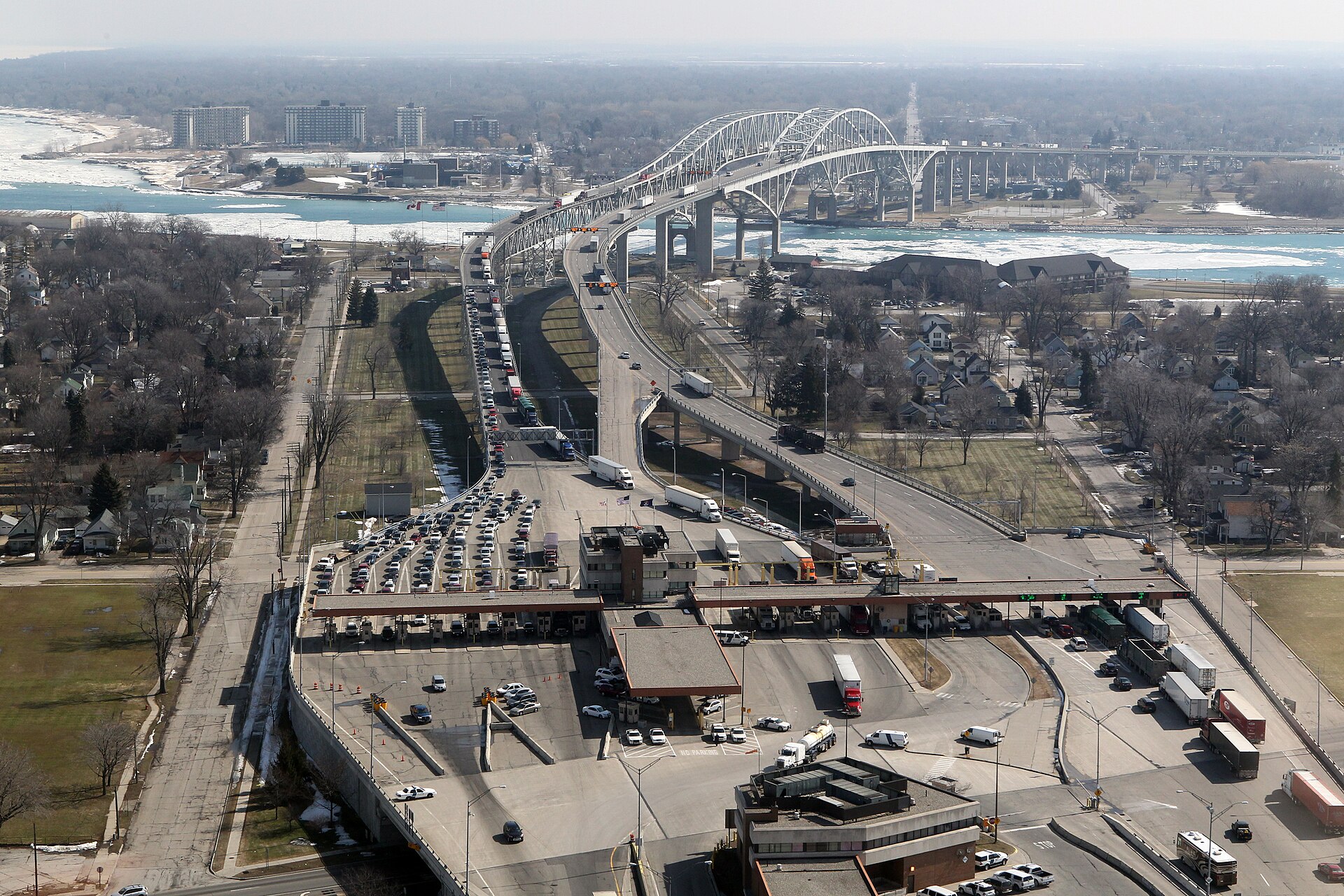
- Lead image: Blue Water Bridge, the twin-span international bridge across the St. Clair River linking Port Huron, Michigan, and Point Edward, Ontario, with trucks at the U.S. port of entry (taken March 17, 2011). Photo: Donna Burton, U.S. Customs and Border Protection (CBP Photography). Public domain. Source: Wikimedia Commons (original: Flickr) (file: media/2026-11-01/cbp-blue-water-bridge-port-huron.jpg)
- @MarkJCarney: Good conversation with President Trump on Canada-U.S. trade. X @MarkJCarney
- @RapidResponse47: Trump on a deal with Canada. X @RapidResponse47
- @RapidResponse47: Trump on the Keystone pipeline. X @RapidResponse47
- @RapidResponse47: Trump on tariffs for U.S. farmers. X @RapidResponse47
- @business: IMO Secretary-General Arsenio Dominguez on Bloomberg This Weekend. X @business
- Bloomberg Podcasts on YouTube: the full Dominguez interview. YouTube
- @ZelenskyyUa: Preparing for a trilateral format in the first half of November (Oct 31). X @ZelenskyyUa
- @ZelenskyyUa: Call with Alexander Stubb and the trilateral technical teams. X @ZelenskyyUa
- @ZelenskyyUa: Overnight attacks on energy infrastructure. X @ZelenskyyUa
Sources
- Wikimedia Commonscommons.wikimedia.org/wiki/File:Blue_Water_Bridge,_Port_Huron,_…
- X @MarkJCarneyx.com/MarkJCarney/status/2116928968771211487
- X @RapidResponse47x.com/RapidResponse47/status/2116996903602991485
- X @RapidResponse47x.com/RapidResponse47/status/2116997241839718596
- X @RapidResponse47x.com/RapidResponse47/status/2116997553765892269
- X @businessx.com/business/status/2116925768387191234
- YouTubeyoutube.com/watch?v=eKWxbKWPAc8
- X @ZelenskyyUax.com/ZelenskyyUa/status/2116596679386243163
- X @ZelenskyyUax.com/ZelenskyyUa/status/2116982811072594158
- X @ZelenskyyUax.com/ZelenskyyUa/status/2116828055234613703
- BBCbbc.co.uk/news/live/cr2kw31g2x3xt
- The Independentindependent.co.uk/news/uk/politics/john-healey-welfare-bill-cha…
- Yahoo Financefinance.yahoo.com/technology/ai/articles/quite-terrible-sam-alt…
- The Blocktheblock.co/post/409675/michael-saylor-teases-another-color-aft…
- Flickrflickr.com/photos/cbpphotos/5764576293